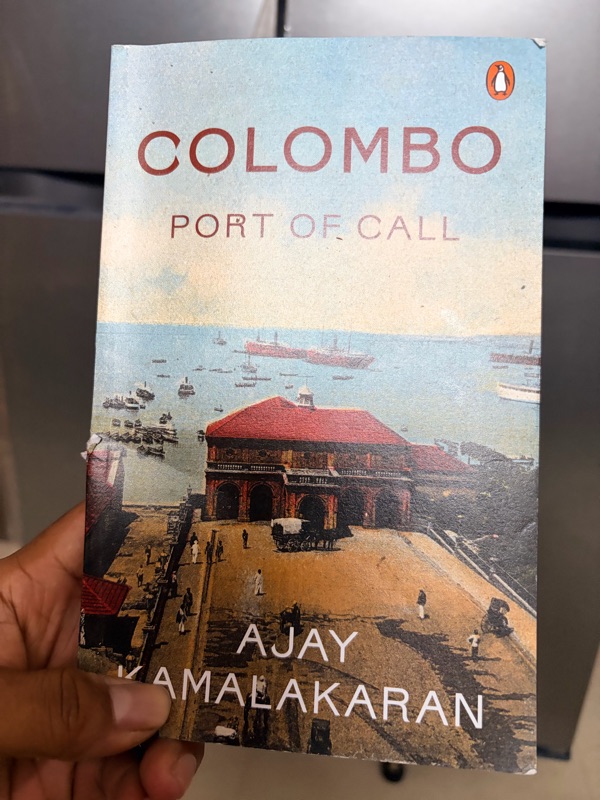
Book Review: Colombo: Port of Call by Ajay Kamalakaran
- Publisher: Penguin India
- Genre: Cultural History / Travel Non-Fiction / Maritime & Archival Narrative
Overview
In Colombo: Port of Call, writer and archival researcher Ajay Kamalakaran constructs a vivid, multi-layered portrait of Ceylon’s capital during the height of the steamship era in the late nineteenth and early twentieth centuries. Rather than presenting a dry, linear historical chronicle, Kamalakaran curates a literary collage through the eyes of 14 diverse global figures—including literary icons, royalty, athletes, and political leaders—who briefly docked at this critical Indian Ocean crossroads on their journeys between the East and West.
Key Themes and Structure
- The Crossroads of Empire: The book captures Colombo's unique geopolitical and cultural identity when it served as an essential refueling and transit hub for travelers moving between Europe, Australia, and East Asia.
- An Eclectic Cast of Perspectives: Kamalakaran draws upon memoirs, correspondence, and periodicals to document the impressions left by historical heavyweights such as Mark Twain, Anton Chekhov, Sir Arthur Conan Doyle, Mahatma Gandhi, Emperor Hirohito, and cricketing legend Don Bradman.
- Social Document and Nuance: Beyond romanticized notions of high tea, luxury hotels, and tropical allure, the text functions as a subtle social document. It evaluates the underlying racial hierarchies, imperialist gazes, and contrasting perceptions of transient visitors against the rich backdrop of local complexity.
Literary Style and Pace
Reviewers and critics note that the book unfolds at an unhurried, reflective pace reminiscent of a classic steamship voyage. Kamalakaran’s background as an archival detective shines through his meticulous research, unearthing fascinating historical snippets and vignettes.
While the inclusion of jottings from both master wordsmiths (like Doyle and Twain) and non-writers introduces a natural stylistic variance, it ultimately grounds the book in an authentic, ground-level human experience of travel. The prose successfully evokes the sensory details of the port city—from its colonial-era maritime bustle to its quiet tropical charm.
Critical Reception
- Strengths: Widely praised for its atmospheric depth, meticulous archival curation, and ability to transport the reader into a bygone era of global maritime transit. Critics note it as an engaging read for both casual travelers and serious students of South Asian history.
- Critiques: Some regional analysts point out minor contextual generalizations—such as framing Ceylon tightly within the broader narrative of the "British Raj" or treating the sovereign complexity of the island nation purely through a transient lens. However, these nuances do not detract from the book's core strength as a charming archival excavation.
Verdict
Colombo: Port of Call is a valuable and evocative addition to Indian Ocean and South Asian travel literature. Ajay Kamalakaran successfully resurrects a forgotten maritime world, offering readers a thoughtful, entertaining, and richly textured glimpse into a city that has long captured the imagination of the world.
Comments
Post a Comment